
Salt of the Church?
Christopher Vella
A few days ago, I was among a small
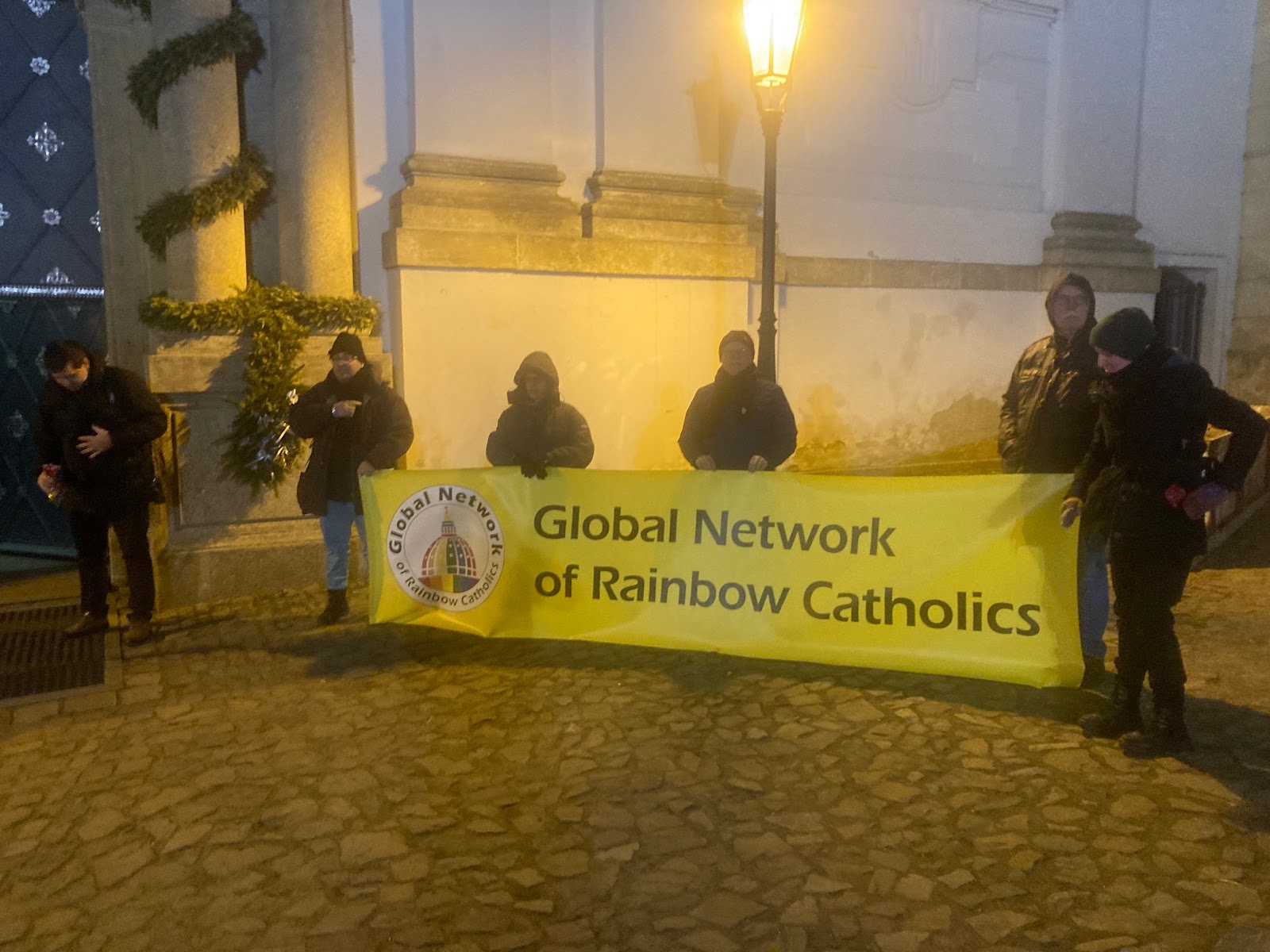
group of Catholic LGBTIQ faithful that gathered outside the Premonstratensian
Church close to the Prague Castle for the opening mass of the Continental phase
of the Synod of the Catholic Church in Europe. We welcomed the official
delegates to the Church service with leaflets, messages, and sweets, with the
banner of the Global Network of Rainbow Catholics serving as the
backdrop. I remember seeing the curiosity of some of the delegates piqued;
others greeted us warmly, while others barely acknowledged us, hurrying into
the Church to avoid even the slightest eye contact. Some, though, came to us,
and pointedly asked us, why are you here? Are you not already part of the
Church? Are you not baptised? What do you need more from the Church? The
same point seems to have been raised later during the Church service, with the
Archbishop of Prague Mgr. Graubner warning the delegates to be wary of those
who come asking for ‘rights’ and put in jeopardy the fundamentals of truth. To
them he appealed to remember what it means to be ‘salt of the earth’!
Salt of the Earth! What a wonderful metaphor of what each
Christian is called to be: To make a difference; to be a beacon; to be a sign
of God’s hope; to be a sign to power. Yet, in the current context, how are
Christians supposed to be the salt of the earth? It depends a lot on one’s
perception of God and His relationship with humanity…
For a very long time, and I would say even up to recently, the emphasis in the Church was mainly on a God who was the sum of doctrines and dogmas, moral codes and precepts, and compliance with Church rules. You were a good Catholic if you knew your catechism, if you obeyed the Church rules, if you attended mass on Sundays and obeyed the moral ethics on sexuality. In that sense, not following or believing in an iota of this corpus of knowledge was tantamount to being a ‘bad’ Catholic. No wonder the alarm of many at the perceived increasing relativism caused by the personalisation of faith, whereby the emphasis apparently shifts from collective objective truths to subjective and apparently self-centred moral ‘choices’. In this context, one can appreciate Mgr. Graubner’s concern that the Church needs to be careful to ‘listen to voice of God’, for ‘many of those who are active in the Church do not know the Bible or the teachings of the Church!’. In my mind’s eye I can see the church as some heroic regiment putting up a brave last stand against the devilish tsunami of the dictatorship of relativism that threatens to sweep humanity off its feet!
This is however a skewed perspective, and one that is unfortunately convenient for those who like to feel as the victims of the present times, portraying a ‘Church under siege’. There is, in fact, a very different perspective, that offers the Church an opportunity rather than a threat, and a golden prospect for renewal that allows it to remain grounded and relevant for a changing world. This perspective is rooted in a different approach to God. God is not a set of dogmas or truths. God is the living experience of relational love. Rather than a rigidly unchanging divinity, God is love who is grounded in our evolving understanding of the world, ourselves, and our relationships. The supreme embodiment of God is of course Jesus Christ, who challenged the moral and doctrinal rigidity of the Pharisees and went beyond their codes to show us a merciful, loving and understanding God who looks at human dignity and seeks ways to unleash the potential to love, which is intrinsic in every human person. For, that is what makes us God’s own image – our capacity to love, our capacity to be God-like, our ‘capax Dei’. The story of salvation narrated in the Bible provides us with a backdrop and a context in which this story of love unfolds and evolves. In it, sexuality is presented as a gift, as an embodiment of this capacity to love, although there are also instances where humans abuse of God’s love and abuse of each other, twisting love into a weapon to harm others. In that respect it ceases being love. On the other hand, the Bible also shows how love rooted in genuine respect for the other person sanctifies both persons and renders them ‘whole’ and ‘holy’. Love cannot be summed in a formula based on rigid moral codes. Nor is it expressed through the abject and senseless negation of one’s sexuality based on some presumed intrinsic disorder. Love is relational, rooted in mutual respect, free will and intentional consent and looks towards faithfulness, steadfastness, and fruitfulness, in the family, community and church.
While it is true that humans can be
self-centred and selfish, our own sexuality holds the potential for us to be
loving and build loving relationships that can and are sacramental. One of our
friends who gathered with us in Prague has been with his husband for over 50
years, and both have persevered in their relationship, loving, forgiving, and
building each other. Another two friends, who were also with us in Prague, have
been a couple for more than twenty years. Through their relationships, these persons
have discovered God and their faith has been enriched. Their awareness of God
has grown, and God has been with them, accompanying them in their mutual
journey of love. Their journey has been a gift to their local community, to
their church and to their mutual families. It is a story of love and
sacramentality that enriches the Church rather than threatening or undermining
the community of faithful. How can this be sinful? How can the Church refuse to
bless it?
The challenge facing the Church is quite a tremendous one. It may follow the first perspective and consider all novelty as a threat and shun all of it, close ranks, and refuse any change that undermines doctrinal continuity. After all, this is a Church that has survived for two millennia, right? To me, such a church would however be following the example of the dwarfs in C. S. Lewis’ Last Battle. While standing in a glamorous well-lit hall in the afterlife, the dwarfs refused to recognise the light and remained blind to it completely. The other alternative is for the Church to look at the new realities and realise that its science is dated, that its approach is ideological, and that its pastoral style is out of touch with the lived reality of people. In a world where religion is more personal than collective, people will not wait patiently forever for a Church that continues to deny their reality and impose unrealistic and unreasonable demands. They will move on. They will search for God wherever they feel His presence, and this may not necessarily be in the church. If that happens, it might be easy to blame the ‘egoistic compulsions’ of people, but in truth, the Church will have itself to blame.
And what about the people who are in the periphery – the outsiders? We do not want to leave the Church, because we love the Church, and it is our family. It might be strange that we want to remain here, while the Church tries its utmost to keep us at arm’s length. Yet, we wish to follow the example of the Syro-Phoenician woman who persisted and persevered in her demand – for her child – despite the apparent indifference and harsh response of Jesus. We saw that bearing in several of the delegates who we welcomed a few days ago. The resilience, faith and determination of that woman was like ‘salt’ that touched Jesus’ heart and compelled him to grant her what she asked for. As I looked at my friends who were with me on that cold night in Prague, I saw many modern Syro-Phoenician women, and admired their resilience, their determination, and their hope.
May our presence act like salt for the
Church. Let this Church listen to God’s voice – as Peter did just before
meeting Cornelius – and believe that ‘what God has made clean, you are not to
call profane (Acts 10, 15). I’ll say Amen to that!

In this workshop led by Simone Ellul, we will use improvisation techniques to deepen skills such as listening, communication and being in the moment, playing games to explore these and other principles. We will work on building trust and will also do some teamwork exercises. This workshop is just an introduction, but it will give us an idea of how certain simple activities and exercises can give us a different perspective and abilities that can then be applied to everyday life.


|
Title: Pastoral
Attention towards Persons with Homosexual Tendencies
|
|
The wording
used in the sub-title and in the question itself immediately poses great
difficulty since it refers to ‘homosexual tendencies’.
This makes homosexuality sound like something pathological or ‘curable’,
while it is scientifically proven that homosexuality is neither of the two.
Suggested alternative wording: Pastoral
attention towards homosexual persons.
|
|
The pastoral care of persons with
homosexual tendencies poses new challenges today, due to the manner in which
their rights are proposed in society.
|
|
Again, this
wording is fundamentally flawed. The real problem is not ‘the way in which
gay people’s rights are proposed in
society’. The real problem is the way in which such people’s fundamental
rights are being denied by society
(sometimes even by the Church).
As Christians we believe that everybody, including
gay persons, has the right to live his life in a dignified way, free from all
types of persecution and discrimination. In many situations and in many
countries it is such a fundamental human right that is being denied. Certainly
the efforts being made to have such rights respected are not to be perceived by
the Church as causing a challenge or a problem to its pastoral mission!
We think that
this sentence should be worded differently: The pastoral care of homosexual persons poses new challenges today,
due to the manner in which such persons have been and are being marginalized
by society, including by some members of the Church.
|
|
40. How can the Christian
community give pastoral attention to families with persons with homosexual
tendencies?
|
|
A homosexual
person is a person. He or she is not a person ‘with homosexual tendencies’ –
just as much as a heterosexual is a person and not just a person ‘with
heterosexual tendencies’. This text should be recast as follows: How can the Christian community give
pastoral attention to families with homosexual persons?
Church members
must be made aware of the trauma that homosexual persons pass through before,
during and after their ‘coming out’. We know from our experience, that many
parents find it extremely difficult to accept their children’s homosexuality,
often owing to their religious upbringing.
Therefore in her
pastoral ministry with families the Church should encourage parents to accept
their children’s sexuality – whatever it is. Always our children! In this way, LGBTI persons would find
acceptance and love in the place where they most expect to find it – at home
and within the Church. Indeed, according to Christian anthropology every
human person is a son or daughter of God, made in His image and likeness.
Hence before being ‘always our children’ such persons are, first and
foremost, always daughters and sons of God. The wording of the previous
paragraph 50 is very pertinent here: “Oftentimes, they (homosexual
persons) want to encounter a Church which offers them a welcoming home. Are
our communities capable of this, accepting and valuing their sexual
orientation?”
It is a known
fact that a significant proportion of suicides is committed by LGBTI persons
– often as a result of not feeling or not being accepted by their families.
This alone brings out the need for much greater tact on the part of bishops, priests
and pastoral workers when speaking of and dealing with these persons.
The Church
should take every opportunity (including this Synod) to be perceived, and in
fact be, shoulder-to-shoulder with homosexual persons and genuinely concerned
by the unjust way in which such persons are treated by society. The Church
should stand,
and be seen to stand, in their defence in the midst of a society that is all
too often hypocritical and hostile towards them.
|
|
What are the responses
that, in light of cultural sensitivities, are considered to be most
appropriate?
|
|
We submit the following
proposals:
1.
The Church needs to review
paragraphs 2357-2359 and 2396 of the Catechism because:
(a) The only place homosexual persons find something written about their
reality in the whole Catechism is under the section entitled: Sins against Chastity.
(b) The present text that reads “This
inclination is in itself intrinsically disordered” (paragraph 2358) must
be removed, especially the words ‘intrinsically disordered’. Nobody has the
right to call ‘disordered’ what God himself has created! In this context the 1997 amendment to
the CCC was a step backwards.
(c) The passages from Scripture and Tradition that are quoted in the
footnotes to sustain Church teaching on this reality need to be reviewed as many
advances in human sciences and biblical studies can shed new light upon this
reality.
2.
The Church should
introduce a Ministry for Lesbian and Gay Catholics (including gay priests and
nuns).
3.
The Church should acknowledge the positive elements
in civil partnerships. In this context the wording of (previous paragraph 52
of) the Relatio post disceptationem
were particularly significant: “there are instances where
mutual assistance to the point of sacrifice is a valuable support in the life
of these persons”. Such unions, rather than undermining the institution
of marriage, actually provide a structure in which people of the same sex who
want a life-long relationship can find their place and protection and the
relevant legal provisions. Such unions can enhance the values of equality and commitment in relationships,
to which the Church already is very committed, because it is equality and the reliability of commitments between people that constitute the
very basis for stability in society.
If the Church starts using a new language towards homosexual believers living in a stable relationship that
is based
on the principles of fidelity, care and love, it
will open up a new pastoral avenue not only with Catholic gay
persons but also with gay persons of other faiths or none.
4. Catholic LGBTIs should be protagonists in the formulation of the
Church’s pastoral care of gays. Such pastoral care should not be about them and for them, but with them
and from them. Through their direct and positive contribution,
gay persons can be an enrichment to the Church
and its vision. “Homosexuals have gifts and qualities to offer to the Christian
community” (previous paragraph 50 of the Relatio
post disceptationem). The Church can listen to homosexual persons
by: (a) inviting LGBTI persons themselves (b) people involved in pastoral
work with LGBTIs (c) theologians who have studied this subject, to be part of
its commissions and study groups, to address the assembly in October 2015, and
to participate in the redaction of Church documents on the subject (see 1 above and 5 below).
5.
We suggest that the Pope
opens up a theological-anthropological discussion on fundamental questions
such as gender, sexual orientation, gender identity, sexuality and the
Scriptures. Such discussion would be expected to continue even after the
October Synod is concluded.
|
|
While avoiding any unjust
discrimination, how can such persons receive pastoral care in these
situations in light of the Gospel? How can God’s will be proposed to them in
their situation?
|
|
What we understand by the words ‘in light of the
gospel’ is: unconditional love, forgiveness, tolerance, openness, acceptance,
being non-judgmental. These are Christ’s own attitudes, and we should derive
our light from Him alone. Such attitudes should be reflected in the Church’s
language, its documents and its ministers’ dealings with gay persons.
A Church that expels its own employees only because they are in a same-sex
relationship or because they have entered into a civil union is not a loving, tolerant, non-judgmental,
non-discriminating mother and/or sister.
All those in pastoral work,
or who are somehow in contact with gay persons and work in this particular
field, should be adequately
trained.
Particularly, seminarians’
formation should include training in this specific area. Such training is to
be given by competent persons with
an adequate background in psychology, since unfortunately there still exist
many myths, misconceptions, ignorance and prejudices about this reality.
|
|
54. Some families have members who
have a homosexual tendency. In this regard, the synod fathers asked
themselves what pastoral attention might be appropriate for them in
accordance with Church teaching: “There are absolutely no grounds for
considering homosexual unions to be in any way similar or even remotely
analogous to God's plan for marriage and family.”
|
|
Is it
possible that when the synod fathers asked themselves what pastoral attention is appropriate, the
only thing that came to mind was that ‘there are absolutely no grounds for
considering homosexual unions to be in any way similar or even remotely
analogous to God’s plan for marriage and family’?
Is a prohibition
the only answer the synod fathers
can offer to millions of gay persons? Is this an appropriate pastoral
initiative?
We
acknowledge that this issue is new to the Church. We also appreciate that the
Church has started to debate and study this reality, and for this we are grateful
to God.
|
|
Nevertheless, men and women with a
homosexual tendency ought to be received with respect and sensitivity. “Every
sign of unjust discrimination in their regard should be avoided” (Congregation for the Doctrine of the
Faith, Considerations Regarding Proposals to Give Legal Recognition to Unions
Between Homosexual Persons, 4).
|
|
Although the Relatio states that ‘Every sign of
unjust discrimination in their regard should be avoided’ it omits any comment
with regard to the unacceptable state of affairs in many countries where
homosexuals are discriminated against, persecuted and even killed. It is
unfortunate that the Church remains silent and fails to condemn the
criminalization of homosexuality and the persecution and harassment of
homosexuals. Such lack of solidarity puts into question the credibility of
the Church regarding its commitment to receive homosexual persons ‘with
respect and sensitivity’.
|
|
55. Exerting pressure in this
regard on the Pastors of the Church is totally unacceptable: it is equally unacceptable
for international organizations to link their financial assistance to poorer
countries with the introduction of laws that establish “marriage” between
persons of the same sex.
|
|
The Church appears
to be more concerned that its pastors are being pressured – rather than
preoccupied by the enormous physical and psychological pressure that is
exerted on gays everyday throughout the world. Therefore, this part of
paragraph 55 should be replaced by a new paragraph that categorically condemns
all countries that criminalize homosexuality at various levels.
As regards the
question of funding: Funding to poor countries by certain organizations is
sometimes linked to certain conditions. But such conditions are not
exclusively gay-related (e.g. those that exert pressure to accept
‘pro-choice’ laws easily come to mind). Therefore this last sentence of para
55 should be removed from here completely and put in a separate paragraph under
a different item and which would condemn all funding to developing countries
that carry ties or conditions.
|

Stħarriġ Ewropew Dwar Persuni LGBT
L-Istħarriġ Ewropew Dwar Persuni LGBT jiġbor l-esperjenzi tiegħek bħala persuna lesbjana, gay, bisesswali jew trans li għandha ‘l fuq
Jekk tagħti 20 minuta mill-ġurnata tiegħek biex timla dan l-istħarriġ ser tgħin ħafna biex jiġu rrappreżentati aħjar l-esperjenzi, opinjonijiet u l-ħtiġijiet ta’ persuni LGBT. Aktar ma’ jkun kbir in-numru ta’ parteċipanti, iktar ma jkunu kredibbli r-riżultati - aħna qed niddependu fuq għexieren ta’ eluf ta’ persuni LGBT madwar l-Ewropa, fl-ewwel servej ta’ dan it-tip - Nistgħu noqgħodu fuqek ukoll?
Qies l-esperjenza tiegħek għax tgħodd u ħu sehem f’dan l-istħarriġ! Qassam l-istħarriġ m’oħrajn billi tagħfas “share” fuq Facebook, Twitter u għid lil ħbieb LGBT dwaru!
European LGBT Survey
The European LGBT Survey collects your experiences as a lesbian, gay, bisexual or trans person who is over the age of 18 and living in the European Union or
Donating just 20 minutes of your day to fill out the survey will really help to better represent the experiences, opinions and needs of LGBT people. The greater number of participants, the greater the credibility of the results – we are counting on tens of thousands of LGBT people across
Make your experience count and take part in the survey! Share on Facebook, on Twitter, and tell your LGBT friends about it!


