Showing posts with label Reflections. Show all posts

21 April 2025

A beacon of hope


Christopher Vella

It was just a few minutes after 10.00 am when my husband Tyrone told me with palpable shock ‘Pope Francis has died’. We rushed to switch on the TV. The news was official. The Pope had really died. Talk of surprises! This was very unexpected. The previous day, Francis was warmly greeting people from the balcony of St Peter’s and even down in the Square. Who would have said that early next morning, he would leave us, so unexpectedly! In the previous days I had frequently reflected on the hidden God, the God who surprises us, who does not follow our human logic and who provides us with the most unexpected surprises when we least expect them. This was one of them.

I had the grace of meeting our dear Francesco a couple of years ago, when together with other fellow leaders from the Global Network of Rainbow Catholics (a network of Catholic LGBT groups around the world) we met him during the weekly audience in October 2023. I remember his words clearly urging us to continue working with our LGBTIQ+ community: andare avanti! Keep working forward. Sow the good news. Sow hope. This is probably what he is telling us right now, as he leaves us for the House of the Father. While it may seem contradictory that he had to leave us during this Jubilee year of hope, he encourages us not to lose hope and entrust our church to the Holy Spirit, the fountain of all hope.

These are indeed bleak times for the world. Just a few days ago my husband and I were reflecting on the political situation. Our world seems to be going back to the 1930s with new authoritarian governments sprouting everywhere, with far-right leaders pouting nonsense and attempting to overturn the very foundations of post World War Two international order and eroding the very basis of democracy. Indeed, Pope Francis seemed to be the only beacon of light, common sense and clear care in a world that is becoming very, very dangerous, for everyone, especially the marginalised and defenceless minorities. Pope Francis seemed to be the only leader in his right mind, who urged us to care for our world, for the refugees, for the migrants, for the defenceless. His consistency, his love for the oppressed, his openness to people on the margins was a shining light of hope in an otherwise bleak and dark world.

During this last Holy Week, I had reflected on the terrible state of affairs in our world and the increasing tensions and new hatreds sprouting everywhere. It seemed like Jesus’ own death had been futile because the world had not seemed to change over the past two millennia. We are still killing people, maiming others, sowing hate against minorities and harming our fragile world. Jesus’ death on the cross thus presented an enigma: God who is almighty and all-powerful choosing instead to show us the true way – not through some great deed, but instead through fragility and vulnerability. The way to renewal is not through some great deed, but through fragile and vulnerable love, willing to give up one’s life to serve others. That is God’s way, the hidden way. Pope Francis too chose this little way, doing away with many of the trappings of glory the Papacy had been associated with, living rather modestly, choosing humble ways to reach out to the poor and weak. He also shared his fragility and vulnerability, choosing not to hide it with a false sense of mightiness, and instead showing God’s way, the path of fragile and vulnerable love. And following the steps of his Master, who even chose the death of night to rise from the death, hidden from the eyes of the mighty, our dear Francesco left us very unexpectedly, very early in the morning, to our surprise and unexpected stupor.

Our Pope left us a great legacy that was itself quite unexpected. Very few expected to see him as Pope. Very few expected some of the most powerful changes he started in the Church – a sense of renewal and a re-living of the spirit of the Vatican Council II. The Universal Synod path he started is itself a sign of hope for the Church, that seemed to have become bankrupted after the horrible revelations of clerical abuse came to light. Now, we place our hope in the same Holy Spirit that moved the Cardinals to choose him, and the same Holy Spirit who moved Pope Francis to start this radical renewal of the Church. I know that this Conclave can well be a make or a break for the Church. We pray that the Lord may guide the Cardinals to choose a Pope that can continue the great work of our holy Pope Francis, and who in turn can be the right beacon to light our world with hope!

May our dear Pope Francis rest in peace! May we be gifted by another holy Pope!

24 September 2024

Drachma's Twentieth Anniversary Painting


Artist: Ellie Abela


The core of this painting is the concept of past, present and future. In particular, the past, present and future of not only Drachma, but the people of the LGBTQIA+ community as a whole. It predominantly uses colour, texture, saturation and spatial perspective to illustrate the transitions between these three time-frames.

The past is illustrated through the use of a monochrome palette, the feeling evoked by this section is bleak and oppressive. This is further aided through the jagged strokes and harsh textures present, as well as the overwhelming shadow surrounding the edge. Despite this, specks of colour are still present, showing that despite the oppression of such a discriminatory environment, we are still present. 

For the present, the spatial perspective is integral to get the message across. Rather than designating a specific colour or texture to represent the present, I decided to illustrate it as a point of transition. In this case, it could be called an open doorway leading to the hopeful future. In a literal sense, the present is where progress is felt and can occur. As is illustrated here, we can see that the light shining from the hope of the future is bleeding into the bleak past, showing that change can and will happen. 

The future is represented in light and colour, as well as a texture that evokes the feeling of celebration. 

The light in the centre alludes to Drachma’s focus on spirituality, and the main colours utilised in this sections are the two colours present in the Drachma logo.

17 February 2023

Salt of the Church?


Salt of the Church?

Christopher Vella


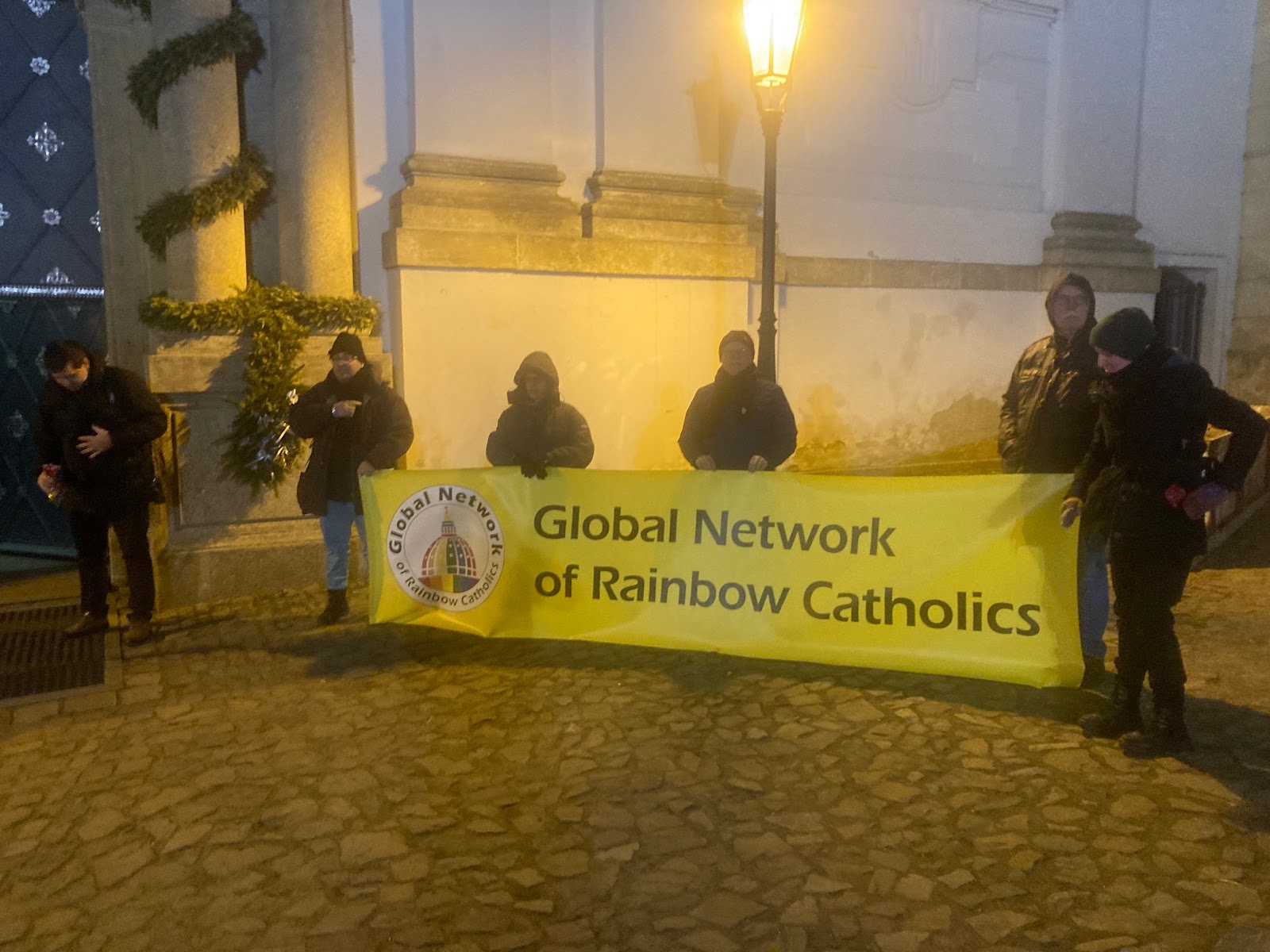
A few days ago, I was among a small group of Catholic LGBTIQ faithful that gathered outside the Premonstratensian Church close to the Prague Castle for the opening mass of the Continental phase of the Synod of the Catholic Church in Europe. We welcomed the official delegates to the Church service with leaflets, messages, and sweets, with the banner of the Global Network of Rainbow Catholics serving as the backdrop. I remember seeing the curiosity of some of the delegates piqued; others greeted us warmly, while others barely acknowledged us, hurrying into the Church to avoid even the slightest eye contact. Some, though, came to us, and pointedly asked us, why are you here? Are you not already part of the Church? Are you not baptised? What do you need more from the Church? The same point seems to have been raised later during the Church service, with the Archbishop of Prague Mgr. Graubner warning the delegates to be wary of those who come asking for ‘rights’ and put in jeopardy the fundamentals of truth. To them he appealed to remember what it means to be ‘salt of the earth’!

Salt of the Earth! What a wonderful metaphor of what each Christian is called to be: To make a difference; to be a beacon; to be a sign of God’s hope; to be a sign to power. Yet, in the current context, how are Christians supposed to be the salt of the earth? It depends a lot on one’s perception of God and His relationship with humanity…

For a very long time, and I would say even up to recently, the emphasis in the Church was mainly on a God who was the sum of doctrines and dogmas, moral codes and precepts, and compliance with Church rules. You were a good Catholic if you knew your catechism, if you obeyed the Church rules, if you attended mass on Sundays and obeyed the moral ethics on sexuality. In that sense, not following or believing in an iota of this corpus of knowledge was tantamount to being a ‘bad’ Catholic. No wonder the alarm of many at the perceived increasing relativism caused by the personalisation of faith, whereby the emphasis apparently shifts from collective objective truths to subjective and apparently self-centred moral ‘choices’. In this context, one can appreciate Mgr. Graubner’s concern that the Church needs to be careful to ‘listen to voice of God’, for ‘many of those who are active in the Church do not know the Bible or the teachings of the Church!’. In my mind’s eye I can see the church as some heroic regiment putting up a brave last stand against the devilish tsunami of the dictatorship of relativism that threatens to sweep humanity off its feet!

This is however a skewed perspective, and one that is unfortunately convenient for those who like to feel as the victims of the present times, portraying a ‘Church under siege’. There is, in fact, a very different perspective, that offers the Church an opportunity rather than a threat, and a golden prospect for renewal that allows it to remain grounded and relevant for a changing world. This perspective is rooted in a different approach to God. God is not a set of dogmas or truths. God is the living experience of relational love. Rather than a rigidly unchanging divinity, God is love who is grounded in our evolving understanding of the world, ourselves, and our relationships. The supreme embodiment of God is of course Jesus Christ, who challenged the moral and doctrinal rigidity of the Pharisees and went beyond their codes to show us a merciful, loving and understanding God who looks at human dignity and seeks ways to unleash the potential to love, which is intrinsic in every human person. For, that is what makes us God’s own image – our capacity to love, our capacity to be God-like, our ‘capax Dei’. The story of salvation narrated in the Bible provides us with a backdrop and a context in which this story of love unfolds and evolves. In it, sexuality is presented as a gift, as an embodiment of this capacity to love, although there are also instances where humans abuse of God’s love and abuse of each other, twisting love into a weapon to harm others. In that respect it ceases being love. On the other hand, the Bible also shows how love rooted in genuine respect for the other person sanctifies both persons and renders them ‘whole’ and  ‘holy’. Love cannot be summed in a formula based on rigid moral codes. Nor is it expressed through the abject and senseless negation of one’s sexuality based on some presumed intrinsic disorder. Love is relational, rooted in mutual respect, free will and intentional consent and looks towards faithfulness, steadfastness, and fruitfulness, in the family, community and church.

While it is true that humans can be self-centred and selfish, our own sexuality holds the potential for us to be loving and build loving relationships that can and are sacramental. One of our friends who gathered with us in Prague has been with his husband for over 50 years, and both have persevered in their relationship, loving, forgiving, and building each other. Another two friends, who were also with us in Prague, have been a couple for more than twenty years. Through their relationships, these persons have discovered God and their faith has been enriched. Their awareness of God has grown, and God has been with them, accompanying them in their mutual journey of love. Their journey has been a gift to their local community, to their church and to their mutual families. It is a story of love and sacramentality that enriches the Church rather than threatening or undermining the community of faithful. How can this be sinful? How can the Church refuse to bless it?

The challenge facing the Church is quite a tremendous one. It may follow the first perspective and consider all novelty as a threat and shun all of it, close ranks, and refuse any change that undermines doctrinal continuity. After all, this is a Church that has survived for two millennia, right? To me, such a church would however be following the example of the dwarfs in C. S. Lewis’ Last Battle. While standing in a glamorous well-lit hall in the afterlife, the dwarfs refused to recognise the light and remained blind to it completely. The other alternative is for the Church to look at the new realities and realise that its science is dated, that its approach is ideological, and that its pastoral style is out of touch with the lived reality of people. In a world where religion is more personal than collective, people will not wait patiently forever for a Church that continues to deny their reality and impose unrealistic and unreasonable demands. They will move on. They will search for God wherever they feel His presence, and this may not necessarily be in the church. If that happens, it might be easy to blame the ‘egoistic compulsions’ of people, but in truth, the Church will have itself to blame.

And what about the people who are in the periphery – the outsiders? We do not want to leave the Church, because we love the Church, and it is our family. It might be strange that we want to remain here, while the Church tries its utmost to keep us at arm’s length. Yet, we wish to follow the example of the Syro-Phoenician woman who persisted and persevered in her demand – for her child – despite the apparent indifference and harsh response of Jesus. We saw that bearing in several of the delegates who we welcomed a few days ago. The resilience, faith and determination of that woman was like ‘salt’ that touched Jesus’ heart and compelled him to grant her what she asked for. As I looked at my friends who were with me on that cold night in Prague, I saw many modern Syro-Phoenician women, and admired their resilience, their determination, and their hope.

May our presence act like salt for the Church. Let this Church listen to God’s voice – as Peter did just before meeting Cornelius – and believe that what God has made clean, you are not to call profane (Acts 10, 15). I’ll say Amen to that!

28 August 2020

Equality or Inequality? Discrimination or equity?

A discerning reflection on the draft Equality legislation

Published on https://newsbook.com.mt/en/equality-or-inequality-discrimination-or-equity/ 11 August 2020.


A lot has been said about school ‘ethos’ and the parameters that define such an ethos and allow educators to work within that ethos, especially, if privately or publicly they may not adhere to that ethos. Should ethos play a role in the recruitment processes? And what, in one’s private and public life, would be considered as unacceptable ’practices’ that an employer would deem as liable for disciplinary action? Should the school ethos determine the content of the curriculum, how it is taught, and the textbooks? Could school ethos be used to forbid certain books to be in a school library, if they are found to spread ideas contrary to the principles expounded by that ethos?

On the other hand, should the State impose a one-size-fits-all curriculum that straitjackets content and principles uncritically? Should the State, through the implementation of any law, muzzle educators who would have to walk a tight-rope, lest they be accused of discrimination, even through non-verbals? Do not schools have a right to their distinctive identity? Do not parents have a fundamental right to choose from the various schools the one that they feel is best for their children? Should any child have the power to throw out an accusation of alleged discrimination against any educator and the onus of proof would be on the educator? Should the educator be considered automatically guilty unless proven innocent?

An inclusive ethos

An institution that is truly embracing would not have any problems with embracing people who are different, and have different opinions and views, subject to the very basic rule of mutual respect towards one another. An embracing ethos would allow discussion and coming together of different views, however different from each other, and allowing all sides the possibility to present their views clearly and in mutual respect. An embracing ethos would welcome difference of race, gender, sexuality and religion without any hindrance and would celebrate the uniqueness of every diversity.

It is one where an educator and a school can freely express their own values and celebrate them, but clearly, in full respect for other dissident values, even if these are embraced by others within the school (including educators) both privately and in public quarters. It does not need to muzzle another person’s views, if the school manages to create a respectful environment that is built on dialogue, sharing of experiences, understanding, and a mutual search for the truth. It is only by learning to use the tool of discernment and applying it critically and equitably to different points of view, that one understands better where the way of truth lies.

Should any school, like the Spanish Inquisition of old, take action against someone who espouses even publicly ideas that go against its ethos? Well, for a first, there is a code of conduct for educators, that regardless of the school and its ethos, should be followed by all educators across the board. That code of conduct guides teachers in the way they dress and behave both on and off campus. But, if an educator is able to espouse his ideas with respect to others, and he does not in any way promote or encourage violence and does not undermine the fundamental human rights of other persons, then, why should anyone stop him? Naturally, there are limits, and there is fundamental respect towards the other. This should not be anarchy, because it could undermine the fundamental human rights of every person.

Conscientious objection

Much has been said about the ‘right’ of people to refuse to promote or implement anything that goes against their ethical and moral beliefs. Fine, in principle. In practice? What if my ethical beliefs are by their very nature exclusive, non-embracing, racist, misogynist or homophobic/transphobic?

It is true that there exist ‘protected characteristics’, but there is the very danger that with the implementation of a vaguely defined conscientious objection, those same ‘protected characteristics’ would be overruled. Unless, that is, a very specific wording is adopted that clearly delineates specific scenarios where that right could be implemented.

The problem is, that we may never completely know how people may try to interpret laws in the future. Something as objectively justified as a ‘conscientious objection’ may well be abused and manipulated towards quite another end. History is replete with such intentional abuses of the letter of the law. How can we truly know if any school leader will not, in some distant future, use conscientious objection for a blanket whitewashing of the protections given by this Equality Bill?

It is understandable, of course, and even legitimate, that the law should protect persons and entities from being forced to do anything that goes against their beliefs. Yet, one also needs to look at it from a different angle as well. There needs to be clear reassurances that the fundamental human rights of the clients requesting a service are respected, especially if these services are within their legitimate rights as regulated by law. The State must ensure that there are other viable and accessible options, while the private institution must still ensure that the human dignity and rights of that person requesting services from it are respected at all times, regardless of whether it can or cannot provide that specific service.

It gets a bit more complicated where schools are involved. Can a school or a teacher refuse to teach a particular topic because it goes against their ethical and moral beliefs? Can they use the conscientious objection to legitimate their refusal? Once again, that is where an inclusive ethos can play a role. As educators we have no right to white-wash or even make invisible realities that are in the world out there. As much as I might not agree with them, I cannot simply give the impression that they do not exist or they are simply wrong because I do not agree with them. That would be a disservice to truth.

This brings us back to the problem of the conscientious objection. That we need a system of clear checks and balances in an Equality law is fundamental. No person’s rights are absolute, if these end up undermining the fundamental human rights of another person. Any Equality Law that tries to create absolute rights would become draconian and self-defeating in the long run. We would be creating a witch-hunt or an illusory and false understanding of ‘rights’ if individuals or institutions are allowed an ‘absolute’ in terms of their conscientious objection.

So, what we really need – if this conscientious objection is to be included at all, is to have clear specific cases where it can be used. Otherwise, we might well be creating a minefield that would render null and void all protections we are busily setting up in this Equality Law.

Conclusion

I look with hope at an equitable society, where people all have a place and a role to play and who are inclusively embraced. I look with hope towards a society that might not need conscientious objection, because we really would know how to respect each other.

Alas, that is not the real world for now.

Instead, let us continue working towards uprooting all forms of discrimination and embrace genuine inclusion.

A better written Equality Law might help. But, let us not muzzle it too much.


C. Vella

21.07.2020

06 March 2019

Gay titwieled jew issir?

Gay titwieled jew issir? Qed insaqsik din id-domanda għax hawn min hu tal-opinjoni li wieħed jaqleb gay għall-gost u biex ikun ipprova kollox f'ħajtu...


Din hija mistoqsija li kont nisma u nistenna ħames snin ilu jew ftit iktar meta forsi kien hawn ħafna inqas awareness mil-lum, anke minħabba li ma kienx hemm l-istess frejmwerk legali ta’ drittijiet bħal ma’ hawn illum. Wara dibattitu sħiħ li kellna f’pajjiżna meta qamet il-kontroversja dwar il-Conversion Practices fl-2016, kont naħseb li mistoqsija bħal din kienet sorvolata. Mid-dehra, il-fatt stess li qed issir din il-mistoqsija, u l-fatt ukoll li qamu wkoll Ä‹erti reazzjonijiet favur il-Conversion Practices fuq il-midja, turi kemm fil-fatt, inbidlu l-liÄ¡ijiet, imma l-mentalità ghadha ma nbiddlitx ghal kollox, u ghal xi uhud baqgħet fejn kienet, u Ä‹erti ideat u misinformazzjoni għad għandhom għeruq fondi.

Illum ix-Xjenza mxiet ħafna u qed turina li l-orjentazzjoni sesswali hija realtà minnha nniffsha u mhix kwistjoni ta’ għażla, jew ta’ aptit, jew xi moda jew trend. Huwa minnu li x-Xjenza għadha ma waslitx b’mod konklussiv għal kollox biex tispjega l-oriÄ¡ini proprja ta’ dan l-aspett fis-Sesswalità tagħna. Imma naħseb ix-Xjenza tal-PsikoloÄ¡ija u s-SesswoloÄ¡ija llum huma ħafna Ä‹ari li din hija naturali u li tiżviluppa fil-bniedem fil-kors tal-ħajja tiegħu. Għalhekk, hemm min jagħraf li hu eterosesswali, u hemm min, jagħraf li hu/hi gay, lesbjana jew bisesswali. Din għalhekk mhix kwistjoni ta’ moda, aptit jew għażla, imma realtà umana. Ħadd ma jqum fil-għodu u jgħid, ‘Illum ħa nkun gay’, jew ‘għada ħa nkun eterosesswali’. Ma tistax illum tkun ‘gay’ u min rajk, jew bl-għajnuna ta’ xi 'prattiÄ‹i', ssir eterosesswali. Jista’ jkun, li tkun għadek qed tfittex, biex anke tifhem lilek inniffsek. Huwa wkoll fatt li s-sesswalità ta’ kull bniedem tevolvi u tiżviluppa iktar ma jagħraf lilu nniffsu u jikber f’dan l-għarfien. Imma din mhux xi swiċċ, jew xi ħaÄ¡a li b'xi prattika ta' konverżjoni tista’ tinbidel. Min jagħmel dan, jew forsi biss jipprova jagħmel dan, ikun qed jagħmel ħsara kbira lilu nnifsu jew lilha nnifisha fl-aħħar mill-aħħar.

Irrid ukoll ngħid, li min jargumenta li xi ħadd jiddeÄ‹iedi li jsir gay biex ikun tal-moda jew sempliÄ‹iment għal gost jew biex tipprova kollox, ikun qed jinsa fatt li għadu reali llum, u li kien iktar fl-imgħoddi: li tkun gay iġġib magħha – sfortunament – element ta’ stigma, preÄ¡udizzju u ukoll Ä‹ertu tbatija psikoloÄ¡ika – għax qed ngħixu f’soÄ‹jetà, li fil-qalbha tagħha, għadha m’aċċettatx verament lil persuni LGBTIQ. L-aktar li wasslet hija li tittollerahom. Il-fatt stess li qed nitkellmu fuq dan il-livell juri kemm għadha sfida – għaliex sa issa stess irrid niġġustifika li neżisti u li jien dak li jien!

(Adattament ta' parti minn Intervista li saret fuq Il-ġurnal Il-Kulħadd, f'Diċembru 2018)

20 March 2016

Conversations by the Drachma Community - March 2016


Listen to the testimonies and experiences of Drachma members as they share their own story and journey of faith and sexual integration. Click on the link below:

https://www.youtube.com/watch?v=PeoxjxCPeHY

05 March 2016

Conversion Therapy and Other Queer Church Conversations


Where are my Latin sisters Still praying to Virgin Mary Rosarios, Novenas, Pomesas, despojos Ave María purísima! Forgive me for loving you The way I do (Vega 1994: 240)[i]

The Curia’s resistant response to the Bill proposing the criminalization of Conversion Therapy provoked strong reactions. As a country, Malta did move far ahead when it comes to legislating to ensure and safeguard the rights of LGBTI communities. But what the Curia’s response tells us, is that the hierarchy of the Roman Catholic Church in Malta is struggling to negotiate between the changes that have taken place within our society, its own understanding and framing of homosexuality, and official teachings which do tie the hands of religious people, particularly Bishops and the Pope, even though in practice it is often talk about sex and sexuality that seems to create panic the most. One has to point out, though, that Pope Francis did bring some balance and has ruffled some feathers on a number of other issues too.  

The Curia’s position paper is to say the least highly problematic (and these have been pointed out by some in the media). At the same time, it does raise interesting, though not unproblematic philosophical questions which should not be entirely dismissed, particularly in regard to individual freedom. The bill does not address the issue of ‘praying over’, often a substitute for conversion therapy. These practices take place in both evangelical and Roman Catholic prayer groups, and as it seems these will continue to take place unquestioned- the bill only limits the practice of professionals. The Curia’s position articulates a number of questions: isn’t an (adult) individual free to choose to repress his or her sexual desires if that person wants to? Aren’t adults who are unhappy with their sexual orientation free to seek conversion therapy if they wish to do so? This is a troubling question, yet one that does raise some issues at the same time. How free is the individual to harm himself or herself? We do know that conversion therapies are deceitful because they promise what we all know can’t be guaranteed with definite assurance. Furthermore, many individuals have and continue to be harmed mainly through North American style boot camps. Peterson Toscano spent seventeen years of his life attempting to change and repress his same-sex orientation and gender differences. He then went on to come out of the closet. He was invited by the Maltese LGBTI Catholic organization Drachma twice to specifically address the matter. At the root of the discussion is not conversion therapy per se, but the understanding of homosexuality as defective heterosexuality and therefore, from that kind of understanding, conversion therapy must therefore follow- to correct.   

The Church’s document raises another important point. It reflects the concerns of some professionals, who, while they do not want to practice conversion therapy, still feel uncertain on the consequences of taking the path of criminalization. I personally feel that there needs to be further dialogue here to address these fears and concerns. Some professionals are asking: at what point can a session become defined as conversion therapy, especially when discussing sexuality with clients who are uncertain and/or confused about their own sexual orientation and sexual desires? Can professionals be falsely accused by clients? Such questions need to be part of the dialogue.  

And yet, there is one point raised by the Curia’s position paper that is extremely interesting and that we seem to have missed in the barrage of press releases and commentaries. The document which the Roman Catholic Church released, tells us that human sexuality can in actual fact be fluid and not confined to gender binaries. This is obviously no news to those who live their sexuality fluidly on a day to day basis, and are comfortable with it. Still, it does reflect at least some alertness and sensitivity to the notion that some may need and want help to better understand their sexual desires and directions they want to take, especially when they do not find themselves in any of the accepted categories that describe and articulate accepted human sexuality.

Interestingly, at the point when Government is legislating to normalize and mainstream sexual diversity, the Roman Catholic Church in Malta is paradoxically and most likely unknowingly saying: ‘Wait! Sexuality is a queer thing!’ While placing a moral judgment on some of those desires, and forcing people in a direction not congruent with their own ‘nature’ and desires is harmful, sexuality, like religion, one may surmise can well be a queer thing indeed. And now we have an official position paper, from the Maltese Curia saying there is a grey area and a complexity to human sexuality and orientations. So now we can perhaps (and finally) start having a serious anthropological-theological discussion about that. (Sadly the Curia’s position paper throws in pedophilia in the grey mix – apologies followed later).

At long last, at least in theory, and if we are to follow any logic in the implications (intended or otherwise), we may then be able to talk with Church authorities about the actual experience of human sexuality including its fluidity and queerness – let’s call them grey areas. As we have been saying for a very long time, the actual human experience of sexuality does not necessarily fit either the gender binary (the Adam and Eve narrative(s) often used (wrongly) to enforce that understanding of human sexuality in religious circles), nor the LGBTIQ narrative, that may perhaps be re-confining us in the same way that the gender binary previously did (though it offers a far more positive and affirmative narrative). 

The issue here is the creation of categories to understand a human sexuality that is itself always defied and subverted by the experiences of human beings. Another critique is that the LGBTIQ discourse is a Western conceptualization of human sexuality, and many in the so called global South fail to identify with those categories, even though there are men who have sex with men, women who love women… Others use different definitions such as sexual and gender nonconformity – language can be indeed limited when it comes to capturing the breadth and depth of the experiences of human sexuality.

Religious and secular definitions of human sexuality often oppose each other in their understanding of what human sexuality is, and what it is for, yet mirror each other in trying to define sexuality through the creation of some or other bounded category within which human sexuality is to be boxed. The document, therefore, most likely unknowingly raises an interesting point about that experience of sexuality, one that cannot be categorized. This, I reckon, may be an avenue for discussion between secular and religious narratives, and possibly also between global North and South narratives as well.   

Secular and religious leaders (not only the Roman Catholic ones) use different starting points to discuss human sexuality and its expression, and it is here that disconnections are wide and deep. What used to be considered as undesirable, is not entirely so from a secular legal point of view and the Church in Malta (not only) is not too sure what to do about all these (‘unexpected’) social developments.

The Roman Catholic Church (again not only) is stuck here. Its tradition and official teachings about human sexuality are not helping it in engaging in dialogue with today’s society. For those of us who have been critically engaged on issues of faith, sexuality, religion and spirituality, we also know that tradition itself and the entire teachings need not necessarily be dismissed, but can instead become tools to help those for whom faith remains an important part of their own lives, to re-visit those same teachings, and to critically rediscover the message of Jesus as liberating rather than an oppressive one.

Pope Francis’ statement ‘who am I to judge’ is tremendously helpful, yet not helpful enough. It does not help the Church in Malta (or any other country) to engage with secular societies and the legal changes to protect LGBTI people and at the same time align itself with those who are opposing these developments. Pope Francis’ message is often very well received, but at the same time can come across as confusing: acceptance limited to a pastoral level, while opposing legal reforms in favor of civil unions. And of course one could say he can’t do otherwise because the teachings of the Roman Catholic Church are what they are. There can be no change from the side of the Church, unless there is a profound transformation of the understanding of human sexuality, but how can the hierarchy of the Roman Catholic Church make such a break from two thousand years of traditions and teachings about human sexuality, and more particularly about homosexuality? But it is also true that when digging through the layers of tradition, other stories emerge, and same-sex love (always interpreted as non physical) is no novelty for Roman Catholic Tradition, and we find quite a few of those narratives in scripture as well.     

The Roman Catholic Church is desperately in need of a new language about human sexuality, and it needs to listen to all research and lay findings and perspectives that have emerged in the past decades across a range of disciplines and sub-disciplines including psychology, anthropology, sociology, queer studies, gender studies, and disability studies among others. It needs to first become comfortable with and then engage a discourse that is inclusive of intimacy, pleasure, and playful delight. It needs to include the role that passion (eros) plays in leading people into relationships and communion, and at times also into conflict and violence. It is here that the Church could offer inspiration in helping societies reflect about sexuality in all of its dimensions, as a potential force for people to enjoy bodily and other pleasures, flourish and construct meaningful relationships or as a force that could also lead to the path of self-destruction or that of others.

The way sexuality is framed and presented by Church authorities does influence the way people live with, and experience their sexual passions, and  at times, especially for those of us who happen to be LGBTIQ, this influence is not a positive one (generally speaking). While theological discourse about human sexuality is affirmative – life is good (for heterosexual people), its application is often limited and fails to offer clear and practical guidance in general. Church authorities do have a knack for coming across as having an entirely negative understanding of human sexuality at a popular level. The Roman Catholic Church needs to learn or re-learn to talk about sex.

The Church itself has a number of religious and lay people, including theologians, who offer this kind of language already, and these are often marginalized. If the Church wants to be vibrant once more, the hierarchy needs to lend its ears to critical theologians and pastoral leaders, and not sideline them or even persecute them. I am recalling Don Andrea Gallo who passed away in 2013, and who often called on powerful authorities within the Roman Catholic Church to develop a more liberating theology of human sexuality that is inclusive of sexual diversity.

The Roman Catholic Church in Malta (and not only) needs to stop functioning like a museum of handed down traditions, of teachings that can only be ‘transferred’ rather than ones that are actively and critically questioned and renegotiated. Rabbi Steven Greenberg tells us that religious traditions need to work their truths through life, and not above it, they need to work inside and across its complexities. Maybe it is time to remember that Roman Catholics may have flirted too much with Greek philosophy and need to rediscover the roots of the rebel rabbi we follow inside, to re-learn from Jewish traditions, where questions are the hallmark of engaging with sacred text, and to remember that religious law should not command the impossible. Jewish teachings could help us deepen our understanding of human sexuality (of course homosexuality a contentious issue there as well).

Catholics need to interrogate those beliefs that led so many baptized LGBTI as well as theologians into exile, while traumatizing so many others, notably the families of those ‘exiled’. We need to reject the idol god fabricated and sold over the years that seems to have a constant hang-up on human sexual desires. The Roman Catholic Church has an opportunity to engage and re-discover the meanings and reasons behind its own sexual rules. After all, Christianity views human sexuality as both a gift and as sacred ground, but only within a set of parameters, and this understanding excludes many other forms of human sexuality, viewed negatively – as flaws in human nature (at least in official teachings). It is time to expand on the sacredness discourse, and also for the hierarchy to ask itself: what is the experience and expression of human sexuality (including its ‘shadow aspect’, that is when it is not life-giving but violent, and used as a weapon to harm others) telling us about our Creator and creation for those who believe? Can those understandings inspire secular society?

If the Roman Catholic Church finds the courage to embark on such a journey, it could offer a service to our contemporary society, where some of the sexually liberated may be searching for a deeper and more meaningful understanding of that liberation. At the very least, those who believe and follow Church teachings, need some of the heavy weight, burden and guilt lifted off their shoulders, because all this does is push people away or forces them to turn inwards.

The Church itself is in dire need to start engaging with and incorporating that which is sexual and spiritual within its understanding of all human beings, including their spirituality, beyond the heteronormative understanding of Creation. And maybe, a secular society with all of its advancements (and misconceptions), could be the fertile ground for today’s Church to find that space for much needed renewal on sexual matters. Maybe secular society needs to also learn not to entirely reject its complex religious history, and be humble enough to also admit that possibly, learning to dialogue with this Other, could be fruitful for society at large. And it is in the fissures, that points of encounter can perhaps be found. 

Mario Gerada is a Maltese activist who tries to navigate between his gay and Roman Catholic identities. Faith, sexuality, religion and spirituality are also academic interests he’s been grappling with for the past fifteen years or so. He is one of the founding members of Drachma LGBTI and Drachma Parents’ Groups.

[i]
Vega, B. (1994) Adónde está la Salsa en SalsaSoul? In Althaus-Reid, M. (2003), The Queer God, Oxon: Routledge.

19 September 2015

EUROPEAN FORUM OF LESBIAN, GAY, BISEXUAL AND TRANSGENDER CHRISTIAN GROUPS PUBLISHES A BOOK ON LGBT CATHOLICS AND THEIR STORIES

The stories of the LGBT Catholics in this book will make a difference in your life” assures Sister Jeannine Gramick in her prologue. Here you will find 34 personal stories divided into the six themes of: Family - Is Catholicism home? - A religious life? - A long journey - Significant events - Working for understanding and acceptance. 


The lesbian, gay, bisexual, transgender and non-gender-binary authors are aged from their 20s to their 80s and come from all walks of life in 13 European countries: Albania, Belgium, Czech Republic, England, France, Germany, Italy, Malta, the Netherlands, Norway, Poland, Russia, and Spain. 


These stories are for reading silently and for reading out loud, by all people - whether religious or not, whether LGBT or not. The authors share their stories of being LGBT and Catholic to help increase awareness, understanding and acceptance of LGBT Catholics and to ease the journeys of those still working on how to live out being both LGBT and Catholic.


* Drachma is a member of the European  Forum

27 February 2015

Reflection on the Church


Veru li dan hu żmien l-Apokalissi? Iż-żminijiet tal-aħħar?
Riflessjoni dwar il-Knisja u r-realtajiet ‘inkwetanti’ fid-dinja kontemporanja

Jekk tmur wara xi bieb ta’ knisja wara l-quddiesa tal-Ħadd u ssaqsi ftit lil xi persuni anzjani, jew forsi xi membri ‘akkaniti’ ta’ għaqdiet kattoliÄ‹i u Ä¡ieli anke xi qassisin u ssaqsiehom dwar ir-realtajiet tal-lum, spiss tisma’ b’ton xi ftit nostalÄ¡iku, li jaħasra, inbidlu wisq l-affarijiet u f’pajjiżna daħlu wisq drawwiet u mentalitajiet kontra r-reliÄ¡jon nisranija u kontra l-Knisja. M’għandix dubju li jekk insaqsihom għal xiex ikunu qed jirreferu, żgur li jsemmu l-libertà (jew libertinaġġ) li hawn f’pajjiżna, kemm qed jitkissru familji, kemm daħlu separazzjonijiet, divorzji, taħwid fil-familji u agħar minn hekk, it-tnedija tal-unjonijiet Ä‹ivili u l-possibiltà ta’ adozzjonijiet minn koppji gay u bdil fil-Ä¡eneru tal-persuni. Tisma’ l-espressjoni: Fiex wasalna!!

Meta titkellem ma’ din ix-xorta ta’ nies tieħu l-impressjoni li s-soÄ‹jetà Maltija ddeÄ¡enerat u li wasalna verament fix-xifer u li jekk ma noqogħdux attenti, ser nispiċċaw nitilfu l-fidi Kattolika f’pajjiżna. Dan isib l-eku tiegħu wkoll fid-dinja globaliżżata tal-lum, fejn hemm tant fenomeni preokuppanti bħat-terroriżmu, l-ateiżmu, il-fundemantaliżmu Iżlamiku, u l-persekuzzjoni tal-valuri nsara speÄ‹jalment mid-dinja atea u akristjana tal-Punent. F’din it-tip ta’ realtà faÄ‹ilment tirreaÄ¡ixxi b’dan il-mod. Qisu, qatt ma kien hemm żmien daqs illum, li l-Knisja u r-reliÄ¡jon Nisranija jinsabu daqstant mhedda u għaldaqstant hemm bżonn inqumu fuq tagħna biex niġġildulha!

It-tentazzjoni tal-vitimiżmu

F’din it-tip ta’ realtà, huwa faÄ‹li li wieħed jadotta l-mekkaniżmu tal-vittimiżmu. Dan ifisser li wieħed jirreaÄ¡ixxi għal dawn ir-realtajiet Ä¡odda billi jħossu parti minn minoranza li qed tiÄ¡i ppersegwitata u li d-drittijiet fundamentali tagħha qed jiÄ¡u mhedda. F’sitwazzjoni bħal din kull att liberali li jsir jiÄ¡i kkunsidrat bħala theddida għall-identità ta’ dak li jkun u bħala att provokattiv lejn Kommunità li essenzjalment dejjem kienet ‘inklużiva’ u ‘tolleranti’. Naslu wkoll biex naħsbu li dawn in-nies li qed jagħmlu dawn il-liÄ¡ijiet Ä¡odda – dawn kollha għandhom l-intenzjoni li jeqirdu lill-Knisja, lill-identità Kattolika tagħna u lill-familja li tant niftaħru biha bħala l-fus u s-sies tas-soÄ‹jetà Maltija.

Hija reazzjoni li fil-fatt qed narawha mhux biss f’Malta imma ‘il hinn minn xtutna. Forsi smajtu bil-moviment Pegida fil-Ä ermanja li qed jissielet kontra dak li huma qed isejħu l-Iżlamiżazzjoni tal-Ewropa. Bħal dawn, imma b’mod differenti, ssib movimenti fl-Italja, fi Franza u fl-Ingilterra li huma kontra l-immigrazzjoni mill-Afrika, kontra l-Ewropa, jew kontra aktar drittijiet għal persuni gay, għax jgħidu li dawn huma kollha elementi li jmorru kontra l-identità, il-kultura u l-familja tal-pajjiż in kwestjoni. Hija interessanti wkoll, li anke l-kommunitajiet IżlamiÄ‹i jpinÄ¡u lilhom nfushom bħala vittmi li qed jiÄ¡u mkassbra mill-Midja internazzjonali (bħal ta’ Charlie Hebdo) u mill-Punent u li fil-fatt m’għandhomx vuÄ‹i u li huma msejkna. Tidħol f’din id-dinamika kollha, l-firda bejn aħna u huma, bejn it-tajbin u l-ħżiena, bejn dawk ta’ Alla u dawk tax-xitan. Imma, din id-dinamika hija ferm perikoluża, u faÄ‹ilment tista’ tiddeÄ¡enera f’mibegħda, u f’Ä‹irku vizzjuż ta’ vjolenza qerrieda.


Il-periklu tal-vittimiżmu fil-Knisja Kattolika

Fil-Knisja Kattolika hemm ukoll dan il-periklu, speÄ‹jalment għaliex il-Knisja hija inkwetata mir-realtajiet ‘Ä¡odda’ fis-soÄ‹jetà tal-Punent li qegħdin jheddu l-familja ‘tradizzjonali’ u li jisfidaw b’mod sfiq id-duttrina morali tal-Knisja fuq diversi punti, inkluż il-LiÄ¡i Naturali, in-natura taż-żwieÄ¡, il-kompożizzjoni tal-familja, is-sesswalità u tant elementi oħra. Spiss il-Knisja tirreaÄ¡ixxi billi tara iż-żjieda apparenti ta’ sitwazzjonijiet irregulari (li jiÄ¡ifieri jmorru kontra t-tagħlim tal-Knisja) bħala theddida fundamentali li rridu niġġilduha sabiex insalvaw il-familja kif Alla riedha. Ħafna drabi l-Knisja twaħħal f’ideoloÄ¡iji Ä¡odda perikolużi bħal ma huma r-Relativiżmu u ‘l hekk imsejħa IdeoloÄ¡ija tal-Ä eneru, għaliex dawn, permezz ta’ lobbying qawwi minn gruppi politiÄ‹i u saħansitra anke minn numru ta’ gvernijiet fil-Punent, qed jirnexxilhom joqtlu u jeqirdu darba għal dejjem it-tagħlim ta’ Kristu fuq in-natura vera u unika tal-familja u tar-relazzjonijiet umani. Il-Knisja għalhekk tħossha fid-dmir li tiġġieled kontra dawn il-kurrenti qerrieda.

Dan ta’ spiss jinħass f’Ä‹erti Ä‹rieki KattoliÄ‹i f’Malta, fejn mhux l-ewwel darba, tisma diskors reminixxenti tal-kruÄ‹jati medjevali kontra l-għedewwa tal-fidi. Spiss minn biżgħat Ä‹kejknin noħolqu iħirsa li jwerwru u nimmaÄ¡inaw li kull liÄ¡i Ä¡dida ser titfa’ lill-pajjiż u lid-dinja fi spirall u abbiss qerriedi, li jekk ma nkunux aħna li nieqfu lil dawn il-kurrenti, possibilta’ jista’ jsir ħsara irreparabli. Smajna dan id-diskors meta daħal id-divorzju, u stennejna li mad-daħla tad-divorzju ser jiżdiedu l-familji mfarrka u ser ikollna dilluvju ta’ żwiÄ¡ijiet li jfallu. Smajna wkoll li jekk jidħol l-unjoni Ä‹ivili, jispiċċa ż-żwieÄ¡ bejn persuni eterosesswali, għax qisu dak li jkun, jitħawwad dwar it-tifsira taż-żwieÄ¡ u allura ser jispiċċa kompletament il-valur taż-żwieÄ¡. Instema’ wkoll li jekk tidħol l-adozzjoni tat-tfal minn koppji gay, f’daqqa waħda, dawn biss ikunu jistgħu jibdew jadottaw u għalhekk ikun hemm impatt terribli fuq il-familja Maltija u ħsara bla tarf fuq it-tfal. Qisu, li jekk jiÄ¡u legaliżżati forom Ä¡odda ta’ familja, il-familja Kattolika tinqered darba għal dejjem. Iżda fil-fatt, l-ebda minn dawn il-biżgħat ma seħħu. Tant hu hekk li minn statistika riÄ‹enti, n-numru ta’ żwiÄ¡ijiet bil-Knisja fl-2014 żdiedu!

Il-Knisja lokali dan l-aħħar bdiet ukoll tuża tip ta’ diskors ieħor fejn iffukkat fuq il-bżonn li jitnaqqas l-impatt ‘negattiv’ ta’ realtajiet morali diversi, bħal ngħidu aħna, nies li sseparaw jew ddivorzjaw, jew li użaw metodi ta’ inseminazzjoni artifiÄ‹jali permezz tal-IVF, jew persuni li qegħdin attivament f’relazzjonijiet bejn persuni tal-istess sess. Il-Knisja tibża’ li dawn l-għażliet morali ‘ħżiena’ jistgħu jkunu ta’ skandlu, speÄ‹jalment għat-tfal u allura persuni li huma fil-maniÄ¡ment tal-iskejjel tal-Knisja jew għalliema tar-ReliÄ¡jon u tal-PSD, għandhom ikunu mħeġġa li jew jirranÄ¡aw l-għażliet morali tagħhom jew għal tal-inqas jostruhom. Il-problema ta’ dan kollu hu li l-Knisja għadha toħlom li t-tfal tal-iskola jgħixu Ä¡o bozza u li dawn ir-realtajiet ma jarawhomx madwarhom.

Niflu sewwa r-realtà ta’ madwarna

Jekk niflu sewwa r-realtà ta’ madwarna, għalkemm hemm verament realtajiet li jistgħu jkunu inkwetanti, però, ikun żball li nqisu dawn il-fenomeni kollha bħala sinjal li s-soÄ‹jetà Maltija sejra l-baħar. Qabelxejn, irridu noqogħdu attenti meta nitkellmu dwar ir-realtà tal-familji Maltin, daqslikieku d-diffikultajiet u s-separazzjonijiet f’pajjiżna huma biss fenomeni ta’ żminijietna. Kultant nagħmlu l-iżball li naħsbu li fl-antik il-familji Maltin kienu dejjem sodi u ma kienx hemm taħwid u tifrik. Fil-fatt, nafu mill-istorja li dan mhux minnu. Tant hu hekk, li fl-imgħoddi kien hawn problemi familjari kemm trid, inkluż sess qabel iż-żwieÄ¡, abort, prostituzzjoni u relazzjonijiet barra miż-żwieÄ¡. U jekk naħsbu li l-omosesswalità hija xi ħaÄ¡a moderna, għandna żball ukoll, għax kienet minn dejjem.

Naturalment, il-periklu hu li npoġġu kull realtà alternattiva fl-istess keffa u nwaħħlu kollox fl-egoiżmu u f’xi deÄ¡enerazzjoni soÄ‹jali. Spiss nippreferu li dawn ir-realtajiet ikunu mistoħbija u li dawn, jekk isiru, isiru b’mod mistur qishom huma xi ħaÄ¡a tal-mistħija. Eżempju klassiku huwa l-prattika tal-omosesswalità. Għall-knisja u għal Ä‹erti setturi fis-soÄ‹jetà Maltija, bniedem gay tajjeb, huwa wieħed li jostor l-identità tiegħu, li ma jkunx sfaċċatament gay u li ma jgħix ir-relazzjonijiet tiegħu b’mod publiku. Allura persuna gay li tkun trid turi s-serjetà tal-imħabba tagħha lejn il-maħbub jew maħbuba tagħha, ma tista’ qatt tagħmel unjoni Ä‹ivili, għax dak hu att publiku u allura qed ikun ta’ skandlu għall-oħrajn. Tifhimha mbagħad li persuna bħal dan mhux adattat biex ikun mudell għat-tfal tagħna! JiddispjaÄ‹ini ngħid li dan mhu xejn tajjeb, għaliex ifisser li għadna ma fhimnix biżżejjed li relazzjonijiet gay u anke relazzjonijiet ‘irregolari’ jistgħu wkoll ikunu sbieħ u ta’ valur daqs kull relazzjoni bejn koppja eterosesswali miżżewÄ¡a. Fuq kollox dawn l-għażliet mhumiex kapriċċ jew qżież imma għażla kultant iebsa minn persuni li jixtiequ jgħixu b’mod Ä¡enwin ma’ dak li Alla nibbet fil-qalb tagħhom. Tagħmel sens li wieħed jgħix indannat għall-ħajtu kollha biex jibqa’ fidil għall-istraitjacket tal-liÄ¡i ortodossa morali tal-Knisja? Mhux aħjar li wieħed jagħraf il-verità tiegħu nniffsu u bi prudenza jagħmel l-għażliet morali li fil-kuxjenza ffurmata tiegħu jinduna li huma l-aħjar għall-Ä¡id tiegħu u ta’ ruħu? Ma jistgħux ikun jewwila li dawn il-liÄ¡ijiet morali jkunu jixbħu lill-madmad tal-liÄ¡i tal-fariżej li Kristu ried isaffi biex verament tagħraf il-ħniena, u l-mogħrija ta’ Alla?


Għażliet morali magħmula b’kuxjenza ffurmata tajjeb

Tista’ tkun tentazzjoni għal min qed jaqra dan l-artiklu biex jgħid: Mela kollox jgħaddi! La kull għażla morali hija tajba, allura, m’hemmx differenza bejn tajjeb u ħażin. Nistgħu nibdew naċċettaw kollox! Fil-fatt, din hija tentazzjoni reali, u jekk il-kejl tal-moralità tagħna jkun ix-xiber tagħna biss u l-egoiżmu tagħna, dan jista’ jwassal biex l-għażliet tagħna ma jkunux tajbin, imma jkunu bbażżati fuq moralità fażulla. Ikun tip ta’ Relativiżmu morali li l-Papa Benedittu XVI tant kien jwissi fuqu.

Imma jien mhux għal din it-tip ta’ attitudni qed nirreferi. Jien qed nitkellem minn għażla morali msejsa fuq riflessjoni sinÄ‹iera u personali, fuq għarfien sewwa tax-xewqat, bżonnijiet u aspirazjonijiet tal-persuna, kif ukoll tiftixa Ä¡enwina u sinÄ‹iera tar-rieda ta’ Alla fil-ħajja ta’ dak li jkun. Trid tkun akkumpanjata minn ħajja ta’ talb, direzzjoni spiritwali u programm ta’ ħajja msejsa fuq il-valuri tal-VanÄ¡elu. Irrid ngħid, li mhux l-istil ta’ ħajja li jiddetermina li wieħed qed jgħix verament ħajja moralment retta, imma l-motivazzjonijiet, il-valuri u l-prinÄ‹ipji, kif ukoll it-tiftixa sinÄ‹iera ta’ Alla fil-ħajja ta’ dak li jkun. Ħa nagħti eżempju: wieħed jista’ jkun miżżewweÄ¡ u jgħix mal-mara tiegħu, imma jsawwatha, jabbużha verbalment, anke jekk mhux daqstant quddiem in-nies. Dan esternament qed jgħix stil ta’ ħajja regolari: hu fidil lejn martu, fis-sens li ma għandux xi skappatura. Madanakollu b’daqshekk mhux qed jgħix moralment tajjeb, għaliex ir-rispett Ä¡enwin lejn il-mara tiegħu ma jeżistix. U kif kien iħobb jirrepeti San Ä orÄ¡ Preca: Mhux il-virtù, imma l-kawża tal-virtù għandha grazzja quddiem Alla!

Huwa importanti li din l-istess metodoloÄ¡ija tiÄ¡i applikata wkoll għall-għażliet morali li apparentement m’humiex konformi mal-liÄ¡i morali tal-Knisja. It-tagħlim stess tal-Knisja jitkellem dwar l-importanza ta’ għażla morali magħmula minn persuni b’kuxjenza ffurmata tajjeb (Katekiżmu tal-Knisja Kattolika, 1776-1802, Gaudium et Spes, 16, Dignitatis Humanae, 1). San Tumas t’Akwinu jgħallem li bniedem jista’ wara proÄ‹ess ta’ dixxerniment jasal biex jiddeÄ‹iedi biex jagħmel Ä‹ertu għażliet morali li ma jkunux konformi mat-tagħlim tal-Knisja (Scriptum super sententiis, 4). Għaldaqstant, quddiem Alla dawn l-għażliet, meta magħmulin b’serjetà u b’reqqa kbira, jistgħu jkunu għażliet ta’ fejda u spiritwalment sani. Fil-fatt, nemmen li persuni bħal dawn jistgħu jkunu wkoll ta’ rowl modils biex juru lit-tfal li huwa possibli li tgħix ħajja Nisranija tajba anke jekk l-għażla personali ma taqbilx strettament mat-tagħlim ortodoss tal-Knisja. Wara kollox, kif jgħid San Pawl (Rum. 6-8), l-ispirtu ta’ Alla jmur ‘il hinn mill-liÄ¡i u jara u jgħarbel dak li hemm fil-qalb. San Pawl fl-Ittra lill-Galatin  (Gal. 5: 16-26) jitkellem dwar il-frottijiet tal-ispirtu li huma l-imħabba, l-hena, is-sliem, is-sabar, il-ħniena, it-tjieba, il-fidi, il-ħlewwa u r-rażan u dawn iservu ta’ sinjal biex wieħed jagħraf jekk fl-għazliet tiegħu hux verament qed jgħix skont l-ispirtu, anke jekk ikun qed jgħix kontra ‘il-liÄ¡i’. Kristu stess kemm-il darba ‘kiser’ il-liÄ¡ijiet tal-Lhud fuq il-jum tas-Sibt għax ħass li l-imħabba tissupera kull liÄ¡i u kull kodiÄ‹i. Madanakollu, hemm bżonn ukoll li l-bniedem ikun tassew koerenti u mhux jgħix, la kif jaqbillu b’mod egoistiku, u lanqas għax mÄ¡iegħel mill-Knisja jew minn kwalunkwe istituzzjoni oħra (Dignitatis Humanae, 1-2, Gaudium et Spes, 16-17). Meta jgħix fil-verità fih inniffsu, ikun qed iħalli din il-verità tagħmlu bniedem integru u Ä¡enwinament ħieles.

Lejn inklużjoni ġenwina

Meta l-Knisja f’Ottubru li għadda ċċelebrat is-Sinodu tal-Isqfijiet ittratat dawn ir-realtajiet Ä¡odda wkoll. Il-fatt li għall-ewwel darba qegħdin niddiskutu dawn ir-realtajiet alternattivi huwa ġà pass pożittiv. Fil-fatt, l-awgurju tiegħi huwa li l-Knisja tkompli tindirizza dawn ir-realtajiet – imma mhux bħala xi velenu perikoluż li qed jhedded il-fundament tal-Knisja. M’għadniex mill-ewwel naħsbu li dawn ir-realtajiet neÄ‹essarjament ser ikissru lill-familja, li d-diversità neÄ‹essarjament hija theddida. Naħseb li dawn jistgħu jgħannu lill-Knisja, għaliex, kif ammetta l-ewwel dokument tas-Sinodu, dawn ukoll għandhom affarijiet pożittivi li jistgħu jkunu ta’ Ä¡id għall-Knisja kollha kemm hi.

Fuq kollox, il-Knisja trid timxi saqajha mhux biss mal-art, imma għandha bżonn tinża’ ż-żarbun u l-kalzetti u tħoss il-qigħan tal-art u tirrealiżża li din mhix realtà ta’ ħażen, imma hija r-realtà tal-bniedem tal-lum u li Alla qiegħed jitkellem mal-Knisja u juri ruħu f’dawn is-sinjali taż-żminijiet. Il-konverżjoni li tipprietka l-Knisja m’għandiex tkun sejħa biex dak li jkun jitlaq mill-istat ta’ ħajja li qed igħix, imma biex f’dak li jkun qed jgħix jifhem iżjed dak li l-Mulej irid minnu u jħalli l-Mulej imexxih. Ta’ spiss ninsew li aħna lkoll midinbin, u mhux biss min hu f’sitwazzjoni hekk imsejħa irregolari, imma wkoll dawk li forsi jippretendu li huma ‘it-tajbin’. Allaħares, il-Knisja tkun il-club tat-tajbin biss, u biex inti tkun Ä¡enwinament aċċettat, tkun trid tikkonforma mal-mudelli ‘tat-tajbin’ fil-Knisja! Fil-fatt, l-irwol tal-Knisja għandu jkun dejjem u biss għas-servizz tal-kuxjenza (Ä wanni Pawlu  II, Veritatis Splendor, 19) u għalhekk, kif jgħid l-Isqof Geoffrey Robinson, il-Knisja għandha b’sensitività tisma’ s-sensum fidelium, jiÄ¡ifieri l-qalba ta’ ruħ il-poplu t’Alla u flok ma tibda mit-teorija, tibda mill-umanità ‘on the ground’ u tiddjaloga mal-bniedem fejn hu. Ma tistax il-Knisja tassumi li min ma jaqbilx magħha awtomatikament ma ffurmax il-kuxjenza tiegħu b’mod tajjeb u għalhekk mhux bniedem rett (Confronting Power and Sex in the Catholic Church, 161-165).

Hemm bżonn niftakru li Kristu dejjem beda mill-bniedem, u mhux mill-liÄ¡i, u li l-mimmi t’għajnejh kienu l-emarÄ¡inati u dawk fil-periferiji. Sfortunament xi drabi ninsew li l-Knisja trid tixbah iktar lil sptar fuq kamp tal-battalja (kif qalilna l-Papa) milli palazz dehbi. Noqogħdu attenti li ma nkunux fariżej, li nwarrbu dawk li fil-fehma tagħna qed jgħixu irregolari, bl-iskuża li dawn ser jiskandaliżżaw lil uliedna. Fuq kollox, hemm bżonn li l-Knisja tibda djalogu Ä¡enwin ma’ dawn ir-realtajiet u takkumpanja lil dawn il-persuni ‘bħala oħt u qaddejja’ (kif jingħad mis-Sinodu DjoÄ‹esan ta’ Malta tal-2004) u mhux tiġġudikahom u tippretendi li taf kollox dwar il-bniedem. Trid tkun umli biżżejjed biex titgħallem iktar mill-esperjenza ta’ wliedha kollha kemm huma speÄ‹jalment dawk fil-periferija, u titħarreÄ¡ Ä¡enwinament fl-istudji tas-SoÄ‹joloÄ¡ija, fl-AntropoloÄ¡ija u fix-Xjenzi l-oħra u tkun lesta biex tħares mill-Ä¡did lejn ir-realtà u tħalli din tixpruna l-iżvilupp tat-tagħlim tagħha u mhux bil-kontra. Għandha tkun lesta li ġġedded it-tagħlim tagħha jekk tagħraf li dak li qed tgħallem mhuwiex totalment koerenti mal-ispirtu ta’ Kristu u mal-valuri veri tal-VanÄ¡elu.

Dan biss għandu jkun il-mod kif il-Knisja twieÄ¡eb għall-isfidi tal-lum. Inkella wisq nibża’ li l-Knisja ser tibqa’ l-art, u tkun hi li titlef lil uliedha u b’hekk tonqos lejn il-kmand ta’ Kristu. Dan hu l-awgurju tiegħi għal din is-sena li matulha l-Knisja qiegħda tkompli tlaqqa’ s-Sinodu tal-Isqfijiet dwar il-familja. J’Alla l-Knisja tkompli ssir il-Knisja tal-Periferija, il-Ä¡emgħa tal-midinbin li qed jinħmew bil-grazzja t’Alla f’qaddisin. U hekk inkunu tassew il-melħ tal-art u d-dawl tad-dinja.


Chris Vella


10 October 2014

Joseanne Peregin: “Fears and hopes as a Catholic mother of a gay son – a parent’s perspective”

Presentation by Joseanne Peregin (President of Christian Life Community, Malta – “LGBT children’s parents’s fears and expectations”) for “The ways of Love”, an International Conference towards pastoral care with homosexual and trans people (Rome, Italy, October 3, 2014)


Never in my wildest dreams would I have ever imagined I would be giving a speech to theologians. But then again, never would I have ever dreamt that one day, I would be the mother of a gay son either. I come from the tiny island of Malta, where everybody knows everyone and most of us are traditional Catholics. I have been happily married for nearly 30 years, and am a proud mother of three children all in their 20s. I have been an active member of the Christian Life Community for over 35 years, 6 of them as president of CLC Malta.

More recently, however my service in the church has evolved as the helpline for parents struggling with their child’s ‘coming out’. In 2008 the DrachmaLGBT group which was established in 2004, had invited St Jeannine Grammick to Malta. After listening to her talk, a handful of us parents decided to meet again and we still meet every month. The Drachma Parents’ Group offers a SAFE SPACE for parents to come to terms with their own process of acceptance. But although it is a SAFE SPACE, it is not a closed space so I am delighted to share this experience with you, although I am certainly no theologian.

I will start from how I dealt with my son’s ‘coming out’ – driven by the Ignatian phrase: ‘God is in all things’. Then, I will explain some difficulties with the Catholic Church’s position on homosexuality. And finally, I will say something about my own ‘coming out’, as a parent. (Probably, my participation at this Conference is like my final stage along this process).

Dealing with my child’s ‘coming out’


So how did my 17- year old son ‘come out’ to me? Well, quite typical of his generation – by sending an SMS! It happened while I was driving him home one evening. We were in the car together so I stopped to read my incoming message and it said: ‘Ma, I’m gay’– isn’t that crazy? ☺) So anyway, I began with the typical denial remarks: like ‘it’s probably just a phase….’ But he stopped me in my words and explained that he had been sure for a long time and he had just told all of his friends. Then he told me he had written ‘the famous letter’ some weeks before, which would explain everything I needed to know, once we got home. Anyway, thankfully when we arrived, my husband (who I thought may react negatively) was fast asleep on the sofa in front of the TV.

So as I read through the letter (my son always wrote very clearly, in fact he became a journalist later in his career)– I felt I could fully understand the whole painful journey he had been through – and like St Paul, I felt the scales came down from in front of my eyes, and I was able to see it all so clearly: why he refused to come to Sunday Mass with us; why all the headaches; why the loss of weight; and why the many tissues inside his dustbin from nights of crying etc. Deep down I felt guilty that he had to go through all that uncertainty on his own – it was not easy for him. Yet on the other hand, I felt a great sigh of relief since I had imagined many worse things like: drugs, terrible sickness, trouble with police, getting someone pregnant etc.

I knew something was wrong, but I never suspected this. So when it was clear that he was gay, I said to myself, “Aaahh! Ok, this I can do, cos all that is needed is love! So I hugged him and assured him of my love. I felt privileged to have such a wonderful relationship with my son – one where he could trust me with something so intimate and special. It was a boost to my motherhood. But then he commanded, ‘I am telling you but I will not tell dad myself, cos I don’t want to have it on my conscience if he drops dead with a heart attack. So if you think he should know, you can tell him yourself, not me’. So that night was the longest night of my life and I didn’t sleep a wink. I had to process all the implications of this new reality that had just landed onto my lap.

I had to choose whether to stand by my 17 year old son or protect my marriage and my reputation in the Church. So I prayed for strength …. and by the morning I chose to stick with my son and be open about it, even if the whole world would turn against us. But it was a difficult decision to take. But I wanted to stand by my son, at such a vulnerable point in his life. So early that morning, I told my husband and the journey slowly unfolded….. and you would be pleased to know, that thankfully after this initial shock, my husband and I are both here.

It seems almost all parents feel this initial shock. Confusion and fear paralyze most parents. But for us Roman Catholics, an added concern is what the Church says about homosexuality. I realized that, when it comes to the LGBT reality, there are many misconceptions and myths that enwrap people in doubt and fear. Although we may have some laws in place that protect the rights of homosexuals, there is still a long way to go until we see the change in culture and mentality that is needed. One of the very first challenges parents of gay children must face is: “What will people say?” but then in Catholic Malta, the second one is: “What does the Catholic Church say?” Unfortunately, this is where many parents get confused and this is where pastoral care is felt most lacking.

For instance, one of the members of our group is a separated mother of a 35 year old gay son. She tells her sad story of being rejected by her own brothers and sisters who before, were very close and supportive while she was going through her separation. But ever since her son ‘came out’ years ago, she and her son were no longer welcome to family weddings or Christmas reunions – they had been excluded by the whole extended family. This resulted in the son taking the blame upon himself and as a consequence, he is often suicidal. And these are people who go to Mass every day and receive the Eucharist – yet find it so easy to judge and to exclude.

I listen to many of these painful stories. To me, pastoral care is about meeting people where they stand and building a friendship with those who feel isolated, distant or cut-off from the Church or even their families – with those who are on the periphery of society – focusing therefore on emotional support and spiritual care.

As Christians we must stand by the side of the poor and rejected, even if it causes us discomfort and humiliation. But there is still a lot of hostility and judgment out there. Our Christian communities need to build bridges and dialogue with those who are at the periphery of society. We need to offer them a SAFE SPACE where they can continue their faith journey. A SAFE SPACE where they can share their vulnerabilities.

So the more I was open about having a gay son, the more I became a magnet for people to approach me and these pastoral friendships began to unfold. In some ways I could offer emotional support and spiritual accompaniment to parents, who like me have experienced, overnight, that we have now become ‘the outsiders’, ‘the others’ who are under society’s critical gaze – ‘the talk of the town among friends and colleagues’, the misfits in society and the outcasts in our own church communities. This is something I experienced myself. I suddenly realised that ‘I too am being judged’ and ‘I too am being excluded’ but I would cling to the words from Isaiah: ‘You are precious in my eyes, you are honoured and I love you’ (Isaiah 43:4).

Anyway, I started to read many articles (eg: ‘Always our Children’) and books (some authors are here today☺) and to learn more about what the Church has to say about homosexuality. I felt however, that there were a number of contradictions in what my church said and what I know about my gay son.

I wanted to unite the two things I love most: my family and my Church. But while my Church refers to my son’s sexuality as ‘intrinsically disordered’, my son refers to my church as ‘judgmental and irrational’. And this interior dilemma is common among many Catholic parents who like me, feel somewhat let down by our own church. So since there was nothing being offered in the Parishes, the Drachma Parents Group offered some pastoral accompaniment and helped parents deal with their trauma:

• denial: ‘It’s just a phase’,
• blame: ‘who’s fault is it?,
• guilt: ‘what should I have not/done?’,
• anger: ‘why did God permit this?’,
• loss/grief: ‘we can’t become grandparents and must give up our dreams’,
• fear: ‘being excluded and judged’, ‘will my son die of HIV Aids?’,
• rejection: ‘should we risk telling family and friends?’,
• loneliness: ‘feeling abandoned even by the church’,
• and shame: ‘have I failed as a parent?’,

With regular bursts of tears and honest sharing in our meetings, we have moved toward a process of acceptance and reconciliation. Drachma takes its name from Luke 15 the parable of the lost coin – I think deep down we all want to be known, appreciated and ‘found’, and when our gay children are no longer hidden but ‘come out’ in the open, then it is our turn to make our own journey of ‘coming out’, as parents.

Dealing with the Catholic Church’s position on homosexuality


Despite my years of commitment and service in CLC Malta, I still tasted the stigma that LGBTIs experience. Whenever I put to question the harsh language used in the Catechism of the Catholic Church such as: intrinsically disordered – oh, how I wish the Bishops would begin this Synod by changing that hurtful phrase!! – I felt I too was being stigmatized. I experienced rejection and exclusion from persons and institutions who knew me well.

For instance: When I attended my first Gay Pride March as a guest speaker of the Family Group LISTAG in Turkey, some people in my community took it against me. I was misunderstood. And when I attended the ILGA Conference in Turin some years ago, I had the chance to know how it feels to be in the minority, (myself among over 200 LGBTIs) – I must have been the only Catholic heterosexual mother over there! It was not an easy experience for me. But this propelled me to appreciate diversity and to continue to act as a bridge.

Church statements lacking in understanding and compassion towards the LGBT situation have pushed away many young people and the church is sadly ‘bleeding’. Priests and Popes have told our homosexual sons and daughters that they cannot express their sexuality in an intimate relationship, in a manner that would naturally lead towards a lifelong commitment. Their life is merely looked upon as an offering of oneself to God only by remaining celibate. These contradictions cause much pain and confusion for parents.

Pastoral care means that our Christian communities must go out of their way to make another feel cared for, to give the opportunity for people to feel special – more accepted, more loved as s/he is. We ‘are sent’ to the periphery to show hospitality and embrace diversity and in doing this, we should be radiating the merciful love of Jesus that goes beyond any family discord, any personal weakness, any community division and any human expectation. We ‘are sent’ – we do not go out of our own accord. It is all about ‘being open’ to the greatest needs around us and then, ‘being sent’ to places where we may be afraid to go. After His Resurrection, Jesus assured his apostles (and us) of His promise: “I will go before you into Galilee” ….. yes, I believe He is ALWAYS ahead of us, ready to accompany us in our pastoral journey.

Dealing with my ‘coming out’ as a parent.


Like I said before, I too experienced being judged and felt the stigma LGBTs feel. The moment my son had ‘come out’ to me, I automatically started my own journey towards my own ‘coming out’ as a parent. This is also a very long and painful journey for us parents as much as it was for our children. While our children would have struggled interiorly for several years, the day we are told or find out our child is gay, we parents somehow have to be ready with the right answers and show the right attitude – but this is not always the case.

In my encounters with parents having gay children, I note that for some parents this news would come to them as the final blow, after a series of several disappointments in life. They shut down or crumble, sometimes having to go on anti-depressants for several months. There is a deep sense of failure which leaves parents feeling paralyzed. These past six-and-a-half years, as a co-founder of the Drachma Parents Support Group, I have met many such parents who feel sorrow and regret about their initial response but they tell me that their child never really ever forgave them for the harsh words exchanged that first day.

In Malta, something that appears to be helping in this healing process is Drachma’s monthly meetings. As I mentioned, we offer a ‘SAFE SPACE’ that welcomes parents who would be struggling with their child’s ‘coming out’. In the beginning, parents are typically quite lost and so we offer some leaflets with information in Maltese since very little exists. We offer encouragement so they can strengthen the bonds in their own family relationships. Sometimes the spouses take opposite positions and argue for months without any progress. But when they come to Drachma they realise they are not alone, and this fills them with hope. They begin to explore new and positive approaches and to understand better this reality and understand their children too.

We learn from each other, we accompany one another during life’s difficult and also happy circumstances. We offer safety, understanding, support and compassion. We pray together, we share experiences, we cry, we pass on good articles and books but we don’t judge, we don’t exclude and we don’t give answers. We provide a vehicle where people are free to come and go, but after a number of meetings, they start to find themselves again and gain deeper perspective – they feel more ready to continue their faith journey in hope. Even if they choose to stop attending, they are still assured that we would still meet every third Thursday of every month! This stability is important in pastoral care.

Something else that works is sending emails to the Bishop. Whenever I listened to a priest’s homily that was delivered with a prejudice tone against gays or whenever the Drachma Community celebrated a wonderful Christmas or Easter Mass, I would write to my Bishop to inform him and give him a most vivid description of the event.

Like me, other members of Drachma took different initiatives. Eventually, this led to building enough interest in the pastoral work of Drachma and some important follow-up meetings were held with the Bishops. Last February the Drachma Parents Group wrote a letter to the Bishop with specific recommendations for the upcoming Synod. And on May 17th IDAHO Mass was celebrated by the Bishop and was made public in the media. This was an important pastoral gesture by our Bishop which also helped to heal some wounds (especially after the Civil Union Law). Recently, I was also invited to give my input during a consultation meeting with the Bishop representing Malta at the Synod and I was one of 20 such advisors – so these humble initiatives are helping to build bridges, gain credibility and strengthen dialogue in the church.

Much of my time these days is spent meeting parents or answering their phone calls, listening and offering friendship. This is pastoral care. Although I feel I have little to offer them, yet there is little else where they feel they can turn to, to share their dilemma about linking ‘gay and catholic’. I usually meet them alone first and they pour out their painful stories.

This releases some of their anxiety and they are able to see some hope in that they are not alone in their journey towards acceptance. When they attend their first monthly group meeting they often find solace in ‘letting it all out’ with parents who understand them since they share a common reality. It is God’s active presence among us that begins the healing process of many, as we listen to one another’s experiences. It is a joy to hear a husband express his gratitude and relief after finally seeing his wife smile for the first time in 12 years by the end of their first meeting.

It was wonderful to watch the elderly couple go home with some renewed hope in their hearts saying, ‘We were afraid you would judge us and scold us for being bad parents, but you’re ok …. you people are nice people’ ☺ She felt SAFE.

And so, from my own ‘coming out’ process I began to realize:
That it’s ok to be identified as a parent of a gay child,
it’s ok to talk about it with others,
it’s ok to stand up in their defense during a casual conversation at a wedding,
it’s ok to stop people from passing unfair remarks or jokes about gays,
it’s ok to write something that shows what side of the fence I am on,
it’s ok to confront a priest about a homily or a Bishop about the words he used in his Pastoral letter in regard to gays.
Yes, it is a gradual but liberating process of becoming a parent, a second time.

St Ignatius of Loyola reminds us to ask: what is the most urgent and universal need? In my view, taking the hostility experienced by LGBTIs upon ourselves, and choosing to defend them instead of judge them, is perhaps the need I see most urgent and universal right now in the life of the church. We need to help stop the bullying that goes on in schools. We need to help persuade countries to change their laws starting with those countries that still consider homosexuality to be a crime. The Church can lead by example.

It needs to address this phenomenon by first showing it is on the side of gays and ready to defend them, with the same determination as when we defend the unborn child. It is important that we reduce the number of attempted suicides by educating people, so as to respect diversity. Immediately following the Bishops’ Synod, the Catholic Church would do well to implement better ways of expressing its support in a concrete and outward way. We should insist on this. If we don’t, who will?

Conclusion:


Yes, our church is tired of pompous judgmental statements – it is tired of clashing symbols and empty words – people want to see real people, real testimonies of hope and love, people who listen, who make themselves available and who are ready to offer their time and their friendship.

So whoever feels lost, hidden or forgotten in the church would be pleased to find us busy right now, (like the woman in the Drachma parable) sweeping up the whole house of God and causing a household stir. They would be happy to know that we value and celebrate their worth and are doing whatever we can to build an inclusive Church. And hopefully, we will REJOICE with our friends, including the Bishops and the Pope!

Originally appeared on Le strade dell'amore